The neighbourhood that reinvented Matera.
Maestranze is here, in the neighbourhood born from Matera's rebirth. Comfortable, lived-in, with free parking and the Sassi a few minutes' walk away.
Why stay here.
Free parking
Leave the car at the door — no restricted zone, no stress. A rare luxury in Matera.
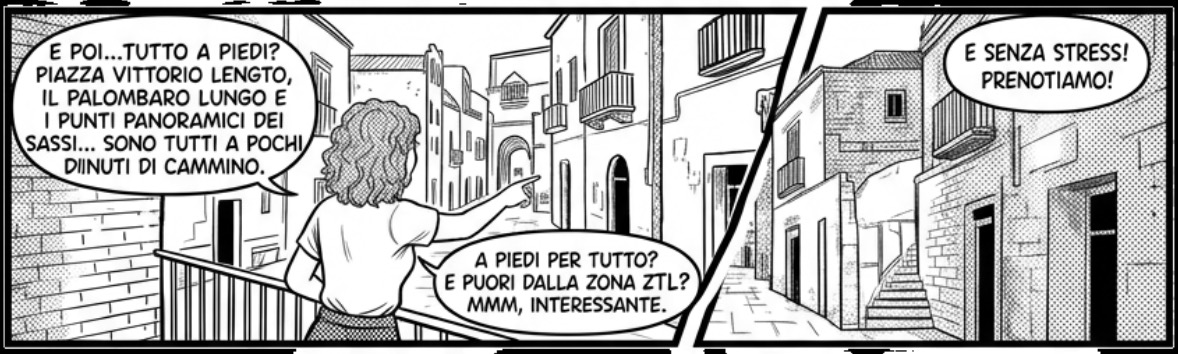
Walk to everything
Piazza Vittorio Veneto, the Palombaro Lungo and the Sassi viewpoints, minutes away on foot.
Architecture to live in
A 1950s neighbourhood designed by Carlo Aymonino: exposed brick, spines, quiet squares.
Real local life
Bakeries, historic pastry shops and little workshops: everyday Matera, away from the crowds.
A city-laboratory.
In the 1950s, after the Sassi were cleared under the special law of 1952, Matera became a unique urban laboratory. To rethink how people should live, a study commission was set up — promoted by UNRRA-Casas and championed by Adriano Olivetti, president of the National Institute of Urban Planning, with the sociologist Frederick Friedmann and scholars of planning, demography and palaeoethnology.
The brief was bold: build new neighbourhoods without breaking the community life of the Sassi. The competition for Spine Bianche was won in 1954 by the group led by Carlo Aymonino (with Chiarini, Girelli, Lenci and Ottolenghi); among the young architects was Giancarlo De Carlo, who designed the long building along the square.
Between 1955 and 1959, 687 homes took shape: exposed terracotta brick, bases in Trani stone, Marseille-tile roofs, a central spine of workshops. No rhetoric — honest, durable materials. Today it is one of the clearest and best-preserved examples of Italian neorealist-rationalist architecture, still studied in schools of architecture.
A turn toward a neorealism guided by an open rationality — without ever renouncing history and tradition.On the architecture of Spine Bianche
In black and white.